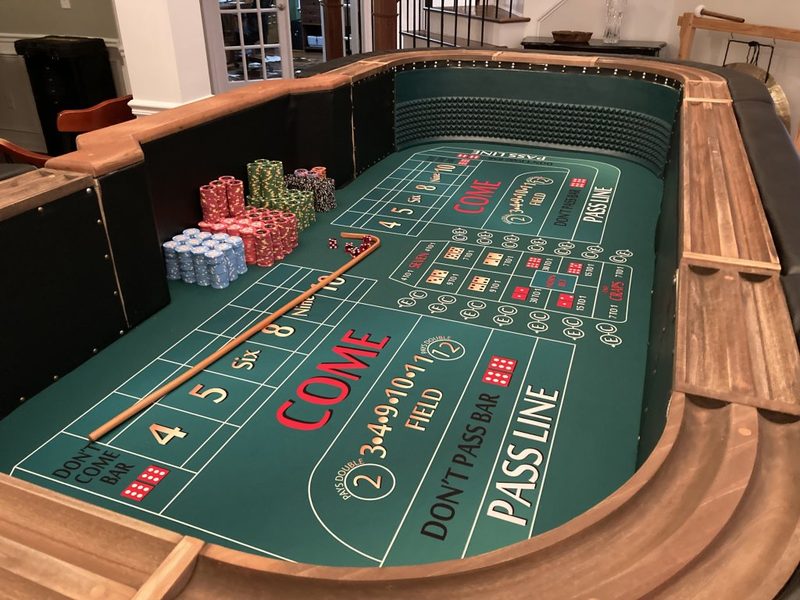
Online craps — play free & master the odds 2026
A free in-browser craps table, bet-by-bet strategy guides, and independent casino reviews — everything you need to play the dice smarter and keep the house edge as low as 1.41%.
Play Craps For Real Money At The Best Casinos!
Hand-picked by our editors. Filter by bonus type, payment method or minimum deposit to find your match.

No casinos match the current filters. Try widening them or click "All".
The complete guide to online craps 2026
Craps looks like chaos, but it hides some of the best bets in the casino. Stick to the Pass Line backed with free odds and the house edge falls to 1.41% — and the odds portion is paid at true odds, with no edge at all. This site covers it all: the rules, every bet and its real house edge, the main variants, and the casinos worth your money.
Start with the free practice table above — it rolls two dice through real come-out and point phases with Pass, Don’t Pass, Come, Field, Place and free-odds bets, so you can learn the rhythm on virtual credits before risking a cent. Then dig into our bet-by-bet guides and independent casino reviews.

Popular craps variants
Live Dealer Craps
Bubble Craps
New York Craps
How to play · 5 simple steps
Place a line bet
Before the come-out roll, drop a chip on the Pass Line — the simplest bet and one of the best on the table.
The come-out roll
The shooter rolls two dice. A 7 or 11 wins for the Pass Line; 2, 3 or 12 (craps) loses; any other number becomes the "point".
Chase the point
Once a point is set, the shooter keeps rolling. The Pass Line wins if that number repeats before a 7 appears.
Back it with odds
Add a free-odds bet behind the line. It is paid at true odds and carries zero house edge — the best value in the building.
Seven-out
If a 7 rolls before the point repeats, the round ends, Pass-line bets lose and the dice pass to the next shooter.
Try Live Craps with real dealers
HD streaming, real dice, chat with the crew.
How craps works
Craps is a dice game built around the roll of two six-sided dice, where the player who throws them is the shooter and everyone at the table can bet on the outcome. The aim isn’t to hit a magic number on every throw — it’s to back the wagers that win as the dice play out. The core flow is the same at every table, while each version’s finer points are covered on the rules page.
The dice and the totals
Everything in craps comes down to the combined total of two dice, a number between 2 and 12. Some totals are far more likely than others, and that simple fact decides which bets are fair and which are traps.
| Roll | Meaning |
|---|---|
| 7 | most likely total; wins on the come-out, kills the point later |
| 2, 3, 12 | craps numbers — Pass Line loses on the come-out |
| 11 | a natural — Pass Line wins on the come-out |
| 4, 5, 6, 8, 9, 10 | box numbers — any of these becomes the point |
The single most common result is 7, which is exactly why it is your friend on the first roll and your enemy once a point is set.
The come-out roll
Every betting sequence opens with a come-out roll, made while the marker puck sits OFF. On the come-out, a 7 or 11 is a natural and the Pass Line wins immediately; a 2, 3 or 12 is craps and the Pass Line loses. Any of 4, 5, 6, 8, 9 or 10 sets the point — the dealer flips the puck ON and moves it onto that number.
How to play: come-out and point
Once you understand the two phases of a round, the rest of craps falls into place. Almost everything you do at the table hangs off whether a point is established.
Establishing the point
If the come-out roll is a box number, that number becomes the point. The puck flips to ON, and the shooter’s job is now to roll that exact total again before a 7 shows up. Nothing else on the Pass Line resolves until one of those two things happens.
The point phase
During the point phase the shooter keeps throwing:
- the point repeats — the Pass Line wins, the round ends, and a fresh come-out begins;
- a 7 appears first — this is a seven-out: the Pass Line loses, the dice pass to the next shooter, and the puck flips back to OFF;
- any other number — nothing happens to the Pass Line; the shooter simply rolls again.
This is why a 7 is celebrated on the come-out and dreaded after a point: the very same total that paid you on the first roll now ends the hand. Holding the dice through several points before a seven-out is what builds a long, profitable shooter.
The bets and their house edges
Craps offers dozens of bets, but only a handful are worth your money. The line bets and their odds backups carry the lowest house edge in the entire casino; the flashy center bets carry the worst. Knowing the number behind each wager is the whole game.
| Bet | Pays | House edge |
|---|---|---|
| Pass Line | even money | 1.41% |
| Don’t Pass (bar 12) | even money | 1.36% |
| Come | even money | 1.41% |
| Don’t Come (bar 12) | even money | 1.36% |
| Free Odds (Pass/Come) | true odds | 0% |
| Place 6 or 8 | 7:6 | 1.52% |
| Place 5 or 9 | 7:5 | 4.0% |
| Place 4 or 10 | 9:5 | 6.67% |
| Field | 2:1 on 2, 3:1 on 12 | ~2.78% |
| Big 6 / Big 8 | even money | 9.09% |
| Any 7 | 4:1 | 16.7% |
The Pass Line and Don’t Pass are the backbone of the game. Don’t Pass is fractionally better at 1.36% because the 12 on the come-out is barred (a push rather than a loss). Come and Don’t Come work exactly like the line bets but start their own come-out on any roll, letting you cover several numbers at once. Place 6 and Place 8 are the only “number” bets cheap enough to recommend; everything in the center of the layout — Any 7, Any Craps, the hardways, hop bets — is a tourist tax. Avoid Big 6 and Big 8 entirely: they pay even money for the same outcome a Place bet pays 7:6.
Online vs land-based, live vs RNG
Craps lives in three formats online, and the differences shape both the atmosphere and the pace far more than the maths.
Live dealer craps
Live dealer craps isn’t a separate rule set but a way of running the game: no random number generator, just real dice thrown on a real table in a studio and streamed to you over live video. A stickman and base dealers run the table exactly as they would in Las Vegas, which gives the format its land-based feel. It is prized precisely for that realism, though it runs slower than the electronic version.
RNG and bubble craps
RNG craps replaces the physical dice with a certified random number generator that reshuffles the odds on every roll — there is no continuity from one throw to the next, and “dice control” or dice setting has no effect whatsoever. Bubble craps is the electronic terminal version of the same idea, where the dice tumble inside a clear dome. RNG tables are faster, run at lower minimums, and usually offer a free demo mode; live tables do not.
| Live dealer craps | RNG / bubble craps | |
|---|---|---|
| Pros | real dice and full table atmosphere; social, authentic pace | low minimums; fast rounds; free demo mode |
| Cons | higher minimums; no demo mode | no human dealer; can feel sterile |
The maths: true odds vs payout odds
Every craps bet hides a gap between the true odds of the event and the payout odds the casino actually pays — and that gap is the house edge. Understanding it is what separates a disciplined player from a hopeful one.
Take Place 4. A 4 can be made three ways out of the six ways a 7 can be made, so the true odds against the 4 hitting first are 2 to 1. A fair bet would pay 2:1; the casino pays Place 4 at just 9:5, and that shortfall is the 6.67% edge. The closer a payout sits to the true odds, the cheaper the bet.
The exception — and the best wager in the building — is the Free Odds bet. Once a point is set, you can back your Pass Line bet with an additional odds wager that is paid at the exact true odds with zero house edge:
| Point | True odds | Pass odds pay |
|---|---|---|
| 4 or 10 | 2 to 1 | 2:1 |
| 5 or 9 | 3 to 2 | 3:2 |
| 6 or 8 | 6 to 5 | 6:5 |
On the Don’t side, lay odds are simply the inverse (1:2, 2:3, 5:6), and they too carry no edge. Because odds bets pay fairly, piling money onto them is the single legitimate way to drag your overall expected loss closer to zero. No betting system changes the dice — the only real levers are bet selection and bankroll discipline.
More craps variants
Crapless Craps
High Point Craps
Simplified Craps
Die Rich Craps
Smart betting
There is no skill that influences how the dice land, so smart craps is entirely about which bets you make and how you manage your money. The plan is short and unglamorous, which is exactly why it works:
- start on the Pass Line or Come (or Don’t Pass / Don’t Come if you prefer the slightly lower edge) and treat that as your base bet;
- always take maximum free odds once a point is set — it is the only 0% bet on the table, so back the line as heavily as your bankroll allows;
- add Place 6 and Place 8 if you want more numbers working, since at 1.52% they are the only Place bets worth making;
- skip the Field, Big 6/8 and every center proposition — the hardways and Any 7 look exciting but bleed 9–17% per roll;
- split your bankroll into many base bets so a cold streak of seven-outs can’t end your session in a few rolls.
Betting systems like the Martingale — doubling after a loss to chase it back — feel like a plan but never escape the house edge; over enough rolls the maths is exactly the same. Discipline beats systems every time.
Best craps casinos: vetted sites for 2026
Dozens of casinos offer craps, but your job is to pick one whose conditions actually favour the player. The biggest factor isn’t the welcome bonus — it’s whether the table lets you back the line with high free odds. Here is what we weigh before recommending a venue:
- Licence — a local permit means your interests are protected by the regulator; at the very least the site should hold a reputable offshore licence (Curaçao or Anjouan, for example).
- Withdrawal speed — the best operators clear e-wallet and crypto payouts within 15 minutes, while card and bank methods may still mean a 1–3 business-day wait.
- Table availability — some venues are dedicated almost entirely to slots and offer only a token craps table or two.
- Odds multiple offered — this is the dealbreaker. A good table offers 3x–4x–5x odds or higher, letting you back a $10 Pass Line bet with $30–$50 of zero-edge odds. A table that caps odds at 1x or 2x forces more of your money onto the 1.41% line bet, quietly raising your real cost to play. Favour high-odds tables — they tell you the casino is comfortable giving players a fair shake.
This site lists only casinos that pass these checks and keep proper high-odds tables available.
How we pick casinos: our rating methodology
Every operator claims their casino is the best, but they can’t all be. We rank venues by objective, craps-specific criteria rather than headline marketing:
- Licence and its standing — a permit from a strict regulator (MGA, UKGC) ranks above a bare offshore licence.
- House edge on the actual bets offered — the odds multiple, whether Place 6/8 pay a true 7:6, and how the Field is structured. Each detail shifts your real cost7.
- High odds multiple availability — tables capping odds at 1x are penalised heavily in our scoring.
- RTP and certification — the long-run return on the RNG tables on offer, verified by independent labs8.
- Withdrawal speed and support in your language, ideally around the clock.
Our rating is a shortcut: it spares you the trial and error of finding out the hard way that a site’s only craps table caps odds at 1x. The full breakdown of our criteria is on the how we rate casinos page.
Welcome bonuses: watch the wagering and game weighting
A tempting welcome bonus is often the deciding factor for new players — but for a craps fan it deserves extra scrutiny, because craps rarely helps you clear it. Weigh every aspect of the offer, not just the headline figure.
The wagering requirement9 is the number you must replay the bonus through before any of it can be withdrawn. A $100 bonus at ×40 wagering means $4,000 in qualifying bets. Miss the deadline in the rules — often 7 days — and the bonus and any winnings from it are voided.
The catch unique to our game: game weighting. Slots usually count 100% toward wagering, but craps typically contributes just 10% — and sometimes 0%. On a 10% weighting, that same $4,000 requirement balloons to $40,000 in craps bets. Some operators exclude craps from bonus play entirely, or cap your maximum bet while a bonus is active because the line bets are too low-edge to be profitable for them.
What ×30, ×40, ×50 wagering means in practice
Wagering shows how many times you must replay the gift before you can cash out the bonus balance. Examples for a $100 bonus, by multiplier — and what the same target looks like once a typical 10% craps weighting is applied:
- ×30 wagering: $100 × 30 = $3,000 in slot bets, or about $30,000 in craps bets;
- ×40 wagering: $100 × 40 = $4,000 in slot bets, or about $40,000 in craps bets;
- ×50 wagering: $100 × 50 = $5,000 in slot bets, or about $50,000 in craps bets.
The honest takeaway: a “craps bonus” is often a slots bonus in disguise. If you mainly play craps, a smaller bonus with fair weighting — or no bonus and a clean bankroll — usually beats a giant offer you can never realistically clear.
Bonuses and how to choose a casino
A bonus programme weighs heavily on which site you pick, but chase the real playthrough terms rather than the biggest headline figure:
- can the bonus be cleared on craps — spoiler: on live dealer craps it usually can’t be at all, or only at a reduced rate10, so you’ll have to play RNG tables;
- how high is the wagering — the gift must be replayed a set number of times before withdrawal: ×30–40 is still acceptable, while ×45 and up most likely mean you’ll never convert the bonus into real money;
- how much time you get to clear it — under 7 days (the standard for a welcome bonus) and you risk simply not making it.
A bonus isn’t the only thing to weigh when choosing a casino. At a minimum, check a few more things:
- licence — valid on the date you play; licences such as Kahnawake, Anjouan and even Curaçao largely mean you can only rely on the operator’s good faith;
- reputation — if neutral forums praise a venue more than they criticise it, your odds of being paid in full and on time go up;
- convenient payments — the casino should support the methods you actually use, credit deposits and clear withdrawals as fast as possible (ideally instantly) and without fees;
- localisation — favour sites with a fully translated interface and support in your language.
And don’t forget a broad table selection: since you’re reading a dedicated craps site, choose a casino that offers both live dealer craps and RNG (including a demo mode) with high odds multiples. How exactly we weigh these factors is set out on the how we rate casinos page. And however good the table, keep your budget in check and play responsibly.
Frequently asked questions
Which craps bet has the lowest house edge?
Is online RNG craps fair?
What is a "point" in craps?
What does "seven-out" mean?
Can I play craps online without registering?
What is the minimum bet in craps?
Are the Field and proposition bets worth it?
Why is craps so popular?
Notes
- A buy-in isn't a final commitment: you can leave the table at any point and exchange your chips back for cash. ↩
- On a $10 Pass Line bet you collect $10 in winnings plus your stake — $20 in all; a $10 free-odds bet on the 4 pays $20 on top of that, at true odds. ↩
- Two six-sided dice produce 36 equally likely combinations. A 7 is the most common total — six of the 36 — which is why it ends the round once a point is set. ↩
- Casinos don't ban betting systems in craps because none beats the dice; a hot streak is variance, not skill, and "dice control" has never been shown to work against a fair table. ↩
- Depending on the bet, the craps house edge ranges from 0% on free odds and 1.41% on the Pass Line up to about 16.7% on the worst one-roll proposition (Any Seven). ↩
- Free odds behind the line are paid at true odds — 2:1 on the 4 or 10, 3:2 on the 5 or 9, 6:5 on the 6 or 8 — and carry no house edge, which is why they are the best value on the table. ↩
- House edge — the casino's built-in mathematical advantage, the share of each bet it expects to keep over the long run. The Pass Line is 1.41% and Don't Pass 1.36%; backing either with free odds drags the combined edge well below 1%. ↩
- True odds vs payout odds — true odds reflect the real probability of a bet; when a bet pays less than that, the gap is the house edge. Free odds are the rare wager paid at exactly true odds, so their edge is 0%. ↩
- Wagering (playthrough) — the requirement to bet the bonus amount a set number of times before withdrawal. ×40 wagering on a $100 bonus means $4,000 in total bets — and far more if craps contributes only 10% toward the requirement. ↩
- Only about 5–20% of the money wagered on craps typically counts toward clearing a bonus. ↩